World Cup 2026: Football Is Still Playing Its Biggest Match Against Homophobia
As the 2026 FIFA World Cup brings millions together, men’s football remains one of the last major sports where coming out is still the exception.
Every four years, the same ritual unfolds. Streets grow quieter, bars fill up, and millions of people hold their breath as the ball enters the penalty area. During a World Cup, it feels as though the entire planet speaks the same language: football.
The 2026 World Cup will be no different. It will be the first to feature 48 national teams and three host countries—Canada, the United States, and Mexico—celebrating a sport that proudly calls itself the world's most universal game.
And yet, one question still lingers.
Where are the gay footballers?
Not because they don't exist. Statistically, that would be impossible. What's remarkable is that, at the world's biggest sporting event, we still know so few of them.
A sport where silence still matters
For decades, football has promoted a very specific image of masculinity: strong, competitive, and emotionally untouchable. In that environment, speaking openly about one's sexual orientation has never been a simple personal decision.
For many players, it has meant risking their place in the dressing room, sponsorship deals, or simply the peace of mind that comes from being able to focus on football.
History proves it.
In 1990, Justin Fashanu became the first top-flight professional footballer to publicly come out as gay. What should have been a personal moment turned into an unbearable burden. Media scrutiny and widespread rejection deeply affected his life until his death in 1998.
More than thirty years passed before similar stories emerged again.
In 2021, Australian footballer Josh Cavallo decided to stop hiding. He was followed by Jake Daniels and Jakub Jankto.
Three players.
Just three publicly known names in a sport with more than 130,000 professional male footballers worldwide.
The gap isn't about statistics.
It's about silence.
Referees face the same reality
That silence doesn't end when the final whistle blows.
Referees live under the same intense scrutiny. Every weekend they make split-second decisions in front of thousands of fans and millions of viewers, yet very few have felt able to be open about who they are.
In 2024, English referee David Coote revealed that he had hidden his sexuality for years out of fear of the personal and professional consequences.
In Spain, no referee has publicly come out as gay while officiating in the country's top division.
Perhaps the issue has never been the absence of LGBTQ+ people in football.
Perhaps it has always been the lack of a safe environment to be visible.
Change also begins in the stands
The game is changing beyond the pitch. Younger generations speak more openly about diversity, clubs are investing in anti-discrimination campaigns, and more supporters want football stadiums to be welcoming spaces for everyone.
But there is still a long way to go.
According to Stonewall, one in four LGBTQ+ people do not feel welcome at live sporting events, while one in five report experiencing discrimination related to their sexual orientation or gender identity.
Women's football offers a different picture. Many players openly share their identities without it overshadowing their careers.
That doesn't mean discrimination has disappeared.
It simply shows that another model is possible.
The match football still has to win
Perhaps that is the real challenge facing men's football.
Not encouraging more players to come out.
But creating a sport where they never have to think twice about doing so.
Football's greatest victory won't come from a last-minute goal or another World Cup trophy.
It will come the day a player posts a photo with his partner, a referee talks openly about his personal life, and nobody considers it headline news.
That will be the day football wins a far more important match than any World Cup.
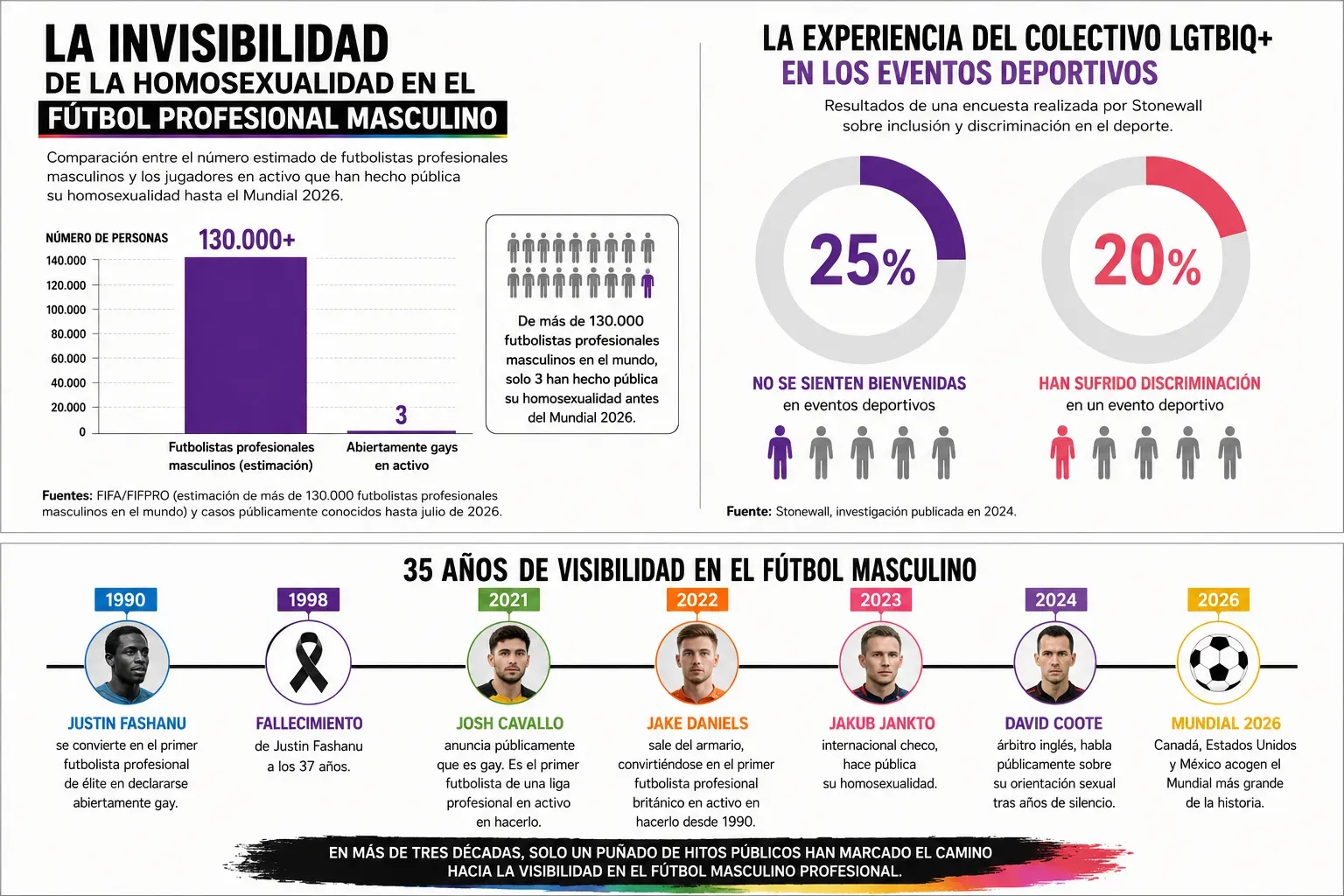
LGBTQ+ visibility in men's professional football has progressed slowly. More than three decades after Justin Fashanu made history, only a handful of players and referees have been able to live openly without their sexuality becoming a major public story.
Sources
- FIFA — FIFA World Cup 2026™
- FIFPRO
- Stonewall (2024)
- Public statements by Josh Cavallo
- Public statements by Jake Daniels
- Public statements by Jakub Jankto
- The story of Justin Fashanu
- Public statements by David Coote