Bonnie Tyler: The Voice That Made Millions of LGBTQ+ People Feel at Home
Bonnie Tyler passed away on July 9, 2026. Her legacy reaches far beyond the hits that defined a generation: she left behind a soundtrack that accompanied the LGBTQ+ community for decades.
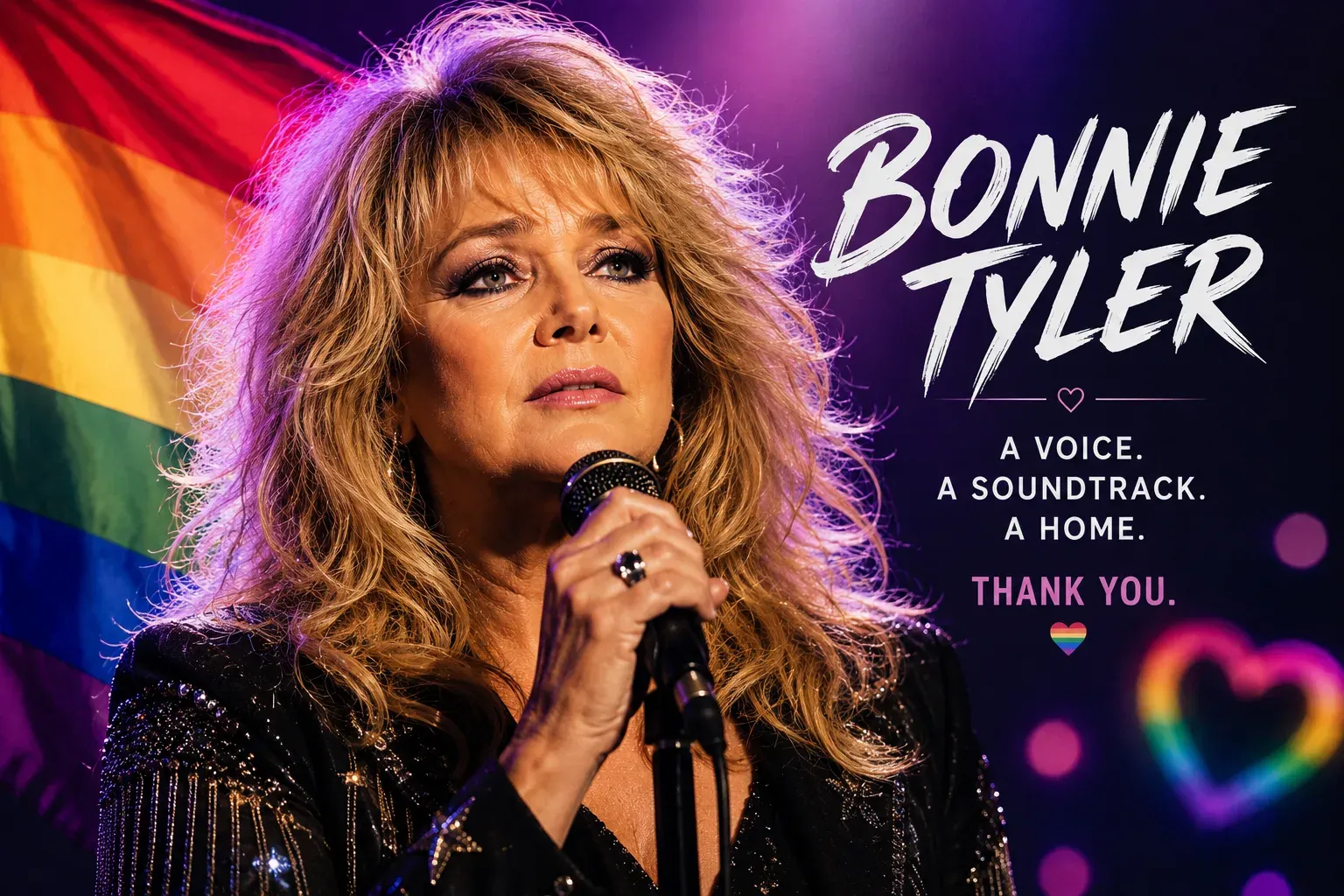
Some artists outlive time because their music speaks to something deeply human. Bonnie Tyler was one of them. On July 9, 2026, she passed away at the age of 75, bringing to a close a career that spanned nearly five decades and gave the world one of the most distinctive voices in pop and rock history. Yet for millions of LGBTQ+ people, her legacy was never measured only by record sales or chart-topping singles. It lived in the emotions she gave a voice to and in the quiet way her songs became part of some of the most meaningful moments of their lives. There is something almost magical about the opening notes of Total Eclipse of the Heart. It doesn't matter your age, where you come from or what language you speak—someone will always stop what they're doing and start singing. More than forty years after its release in 1983, the song continues to fill karaoke bars, dance floors and Pride celebrations around the world. It never mentions sexuality or gender identity, yet its emotional intensity, theatrical drama and overwhelming portrayal of love made it a natural part of queer culture. It became one of those rare songs that no longer belongs only to its writers or performer, but to everyone who has ever found a piece of themselves within it. Perhaps that connection begins with Bonnie Tyler herself. The raspy voice that became her trademark emerged after surgery on her vocal cords—an operation that could easily have ended her career. What initially seemed like a setback eventually became the very quality that made her unforgettable. At a time when the music industry chased flawless voices, Bonnie sounded different, imperfect and undeniably authentic. For many LGBTQ+ people who grew up being told they were "too different," there was something profoundly reassuring in watching an artist turn what set her apart into her greatest strength. Throughout the 1980s and 1990s, when being openly LGBTQ+ still meant living with fear in many parts of the world, queer bars and clubs were much more than places to dance. They were sanctuaries where people could finally be themselves, meet others like them and forget, if only for a few hours, everything waiting outside. Those dance floors had their own soundtrack, and Bonnie Tyler's music became an essential part of it. Holding Out for a Hero, It's a Heartache and, above all, Total Eclipse of the Heart accompanied generations at a time when LGBTQ+ representation in mainstream music and television remained painfully scarce. Reducing Bonnie Tyler's relationship with the LGBTQ+ community to her songs alone, however, would miss an important part of her story. She never set out to become a queer icon, nor did she use that connection as a marketing strategy. She simply responded with warmth, gratitude and genuine respect to the love she received. Throughout her career she performed at venues beloved by LGBTQ+ audiences, appeared at Pride festivals and openly acknowledged the unwavering support the community had shown her since her earliest successes. At a time when many public figures remained cautious about expressing solidarity for fear of alienating audiences, Bonnie chose authenticity. She never saw different audiences—only people who loved music. Her legacy, then, reaches far beyond platinum records and international hits. It lives in countless personal memories that can never be measured: the first dance with someone you loved, the first Pride where you felt truly free, the drag performance that ended in tears and applause, or a group of friends embracing one another as one of her unforgettable choruses echoed through the room. These are small, deeply personal moments, yet together they are what transform an artist into part of a community's collective memory. The history of the LGBTQ+ community has also been written through music. Through songs played in bars where people could finally be themselves, at demonstrations demanding equality and on dance floors where, for a few precious hours, fear disappeared. Bonnie Tyler never needed to write explicitly queer anthems to become part of that history. She simply gave voice to universal emotions that found an unexpected home within our community. The world lost an unforgettable voice on July 9, but truly great artists never disappear completely. They remain in the songs we turn to when we need to celebrate, remember or simply feel understood. As long as there is a rainbow-lit dance floor, a karaoke room filled with people singing at the top of their lungs or someone finding comfort in a melody they have known by heart for decades, Bonnie Tyler will remain part of our story. Some voices fade. Others, like hers, become a place we can always return to.