New city, no friends.
The part of the queer moving story nobody puts in the caption: the weeks where you know the coffee shops and nobody at all.
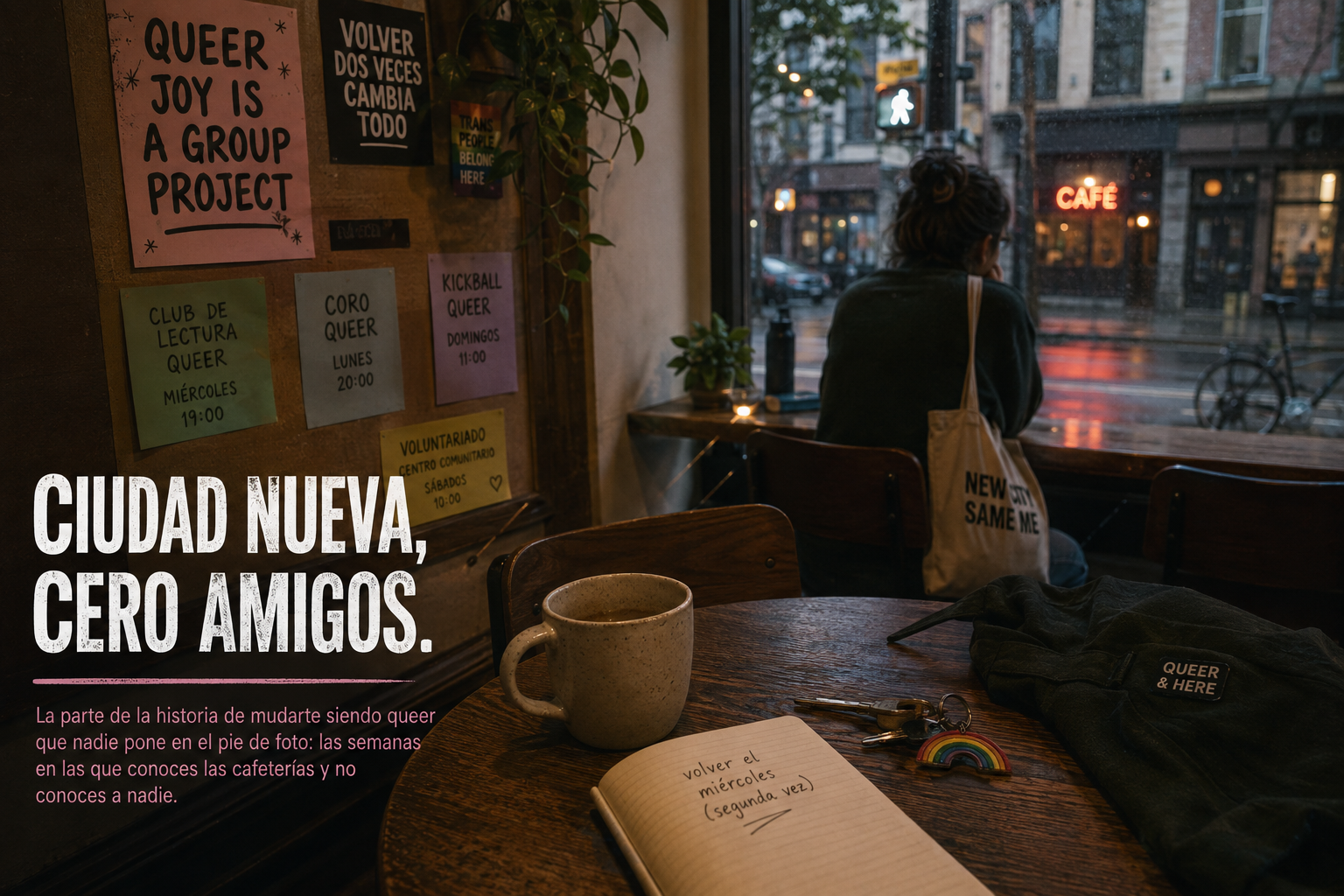
You know this phase even if you've never lived in this exact city before. The apartment is unpacked before your life is. You've found the good grocery store and the pharmacy and the route that avoids the worst intersection. What you don't have is a single person who would notice if you disappeared for a week. You had a whole cast of people in the last place — not best friends, necessarily, just the group chat, the person who waved at you at the bar, the friend-of-a-friend who always had a couch. Here, none of that exists yet, and there's no shortcut that skips the part where it doesn't.
The apps aren't built for this
At 11pm you'll open the apps anyway. The dating ones weren't made for "I just want someone to know my name." The friend-finding ones fill up with people who are also new and also waiting for the other person to make the first move, so you both sit there, matched, silent. Scrolling a city's queer hashtags shows you a party that happened, a flyer for something already sold out, a reel of people who look like they've known each other for a decade. None of it is a way in. It's a window with the glass still up.
Nobody is going to invite you first
This is the part worth saying plainly instead of softening: most of the friend groups already in that city took years to form, and they are not sitting around with room reserved for you. That's not a reflection on you and it's not a flaw in the city — it's just what settled social life looks like from the outside. Waiting for an invitation is waiting for something that isn't coming, because the people who'd send it don't know you exist yet.
What actually works is smaller than it sounds
Not a big night out. A recurring thing, and going alone. A queer rec sports league — kickball, dodgeball, volleyball — where you're assigned a team instead of having to build one. A bookshop's queer reading series, the same night every month. A volunteer shift at a community center or a clinic, where you're standing next to the same handful of people doing a task, which is a much easier way to talk to strangers than eye contact at a bar. A choir. A run club. A board game night at a queer-owned space. None of it requires charisma. It requires a recurring time and place, and you, twice.
The second time is the whole trick
The first time you show up to any of these, you're a stranger and nobody clocks it — that's fine, that's supposed to happen. The second time, someone says "oh, you're back," and that sentence is doing more work than it looks like. That's the actual hinge point, not the party, not the app match, not the big welcoming gesture nobody's obligated to make. It's a stranger becoming a regular, which is the only route to becoming someone's friend.
This is the whole reason a directory like this exists — not to promise you a party where everyone already knows your name, but to make it possible to find the recurring, unglamorous, real thing happening near you this week, so you can go back a second time. A few months from now, you'll be the one who says "oh, you're back" to somebody else. That's not a bigger moment than it sounds. It's the same size as the one someone gave you.